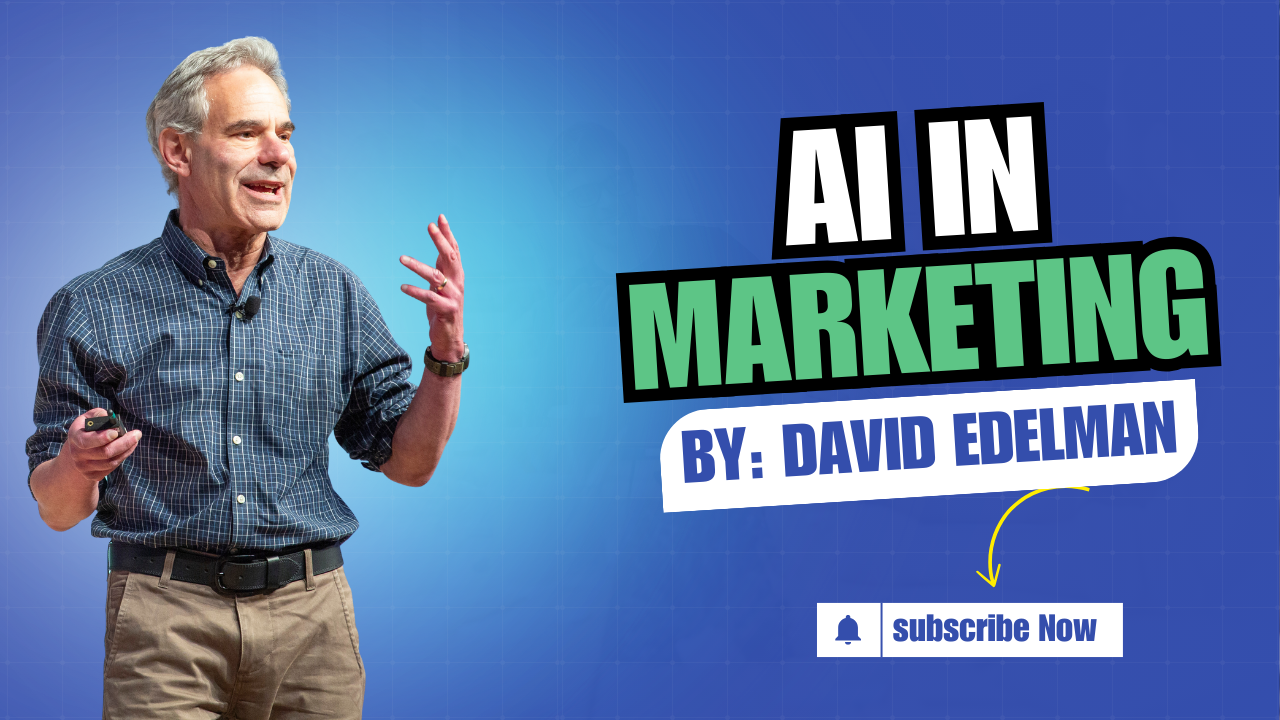
AI in Marketing – How to Get Real Leverage
Exploring where AI creates leverage across the end-to-end marketing process, beyond content creation.
In 100 Words
This community session explores where AI creates leverage across the end-to-end marketing process, beyond content creation. The discussion outlines how tools can detect market signals, recommend actions, define audiences, generate and QA creative, execute campaigns with testing, and consolidate performance insights. The discussion stresses that marketers are not being replaced; rather, capabilities are being stitched together, with data integration as a linchpin. Examples include AI-assisted legal framing for referral programs, AI-driven segmentation, multivariate testing for personalization, natural-language reporting, and an integrated Verizon churn-prevention flow that materially lifts response rates.
Full Session
Key Learning Points
AI Beyond Content Creation
Most marketers currently use AI primarily for time savings and productivity, especially in content creation, but the real leverage extends far beyond.
End-to-End Campaign Support
AI capabilities can support nearly every step of campaign delivery: detection, recommendations, targeting, copy generation, execution, QA/compliance checks, and performance synthesis.
Integration Over Isolation
The 'end-to-end' value often comes from integrating multiple tools and engines rather than relying on isolated point solutions.
Data as Cornerstone
Data integration is presented as a cornerstone capability that unlocks downstream personalization, targeting, and cross-domain insights.
Distinct Engine Roles
Different 'engines' can play distinct roles: insights (identify opportunities), personalization (message/channel/timing), action execution (orchestration through systems), and rules/compliance (guardrails).
Generative Content for Testing
Generative content at scale is described as powerful not only for producing assets but also for enabling constant testing and learning.
Beyond A/B Testing
Multivariate testing expands beyond traditional A/B by optimizing combinations of variables and tailoring outcomes to individuals or segments.
Natural-Language Querying
Natural-language querying across disparate databases can reduce reporting effort dramatically and enable faster action from insights.
Integrated Personalization Impact
Integrated personalization can significantly lift performance (e.g., Verizon's reported tripling of response rate), but requires planning and coordination.
Risks and Tensions
Risks include 'a thousand flowers blooming' (too many actions), coordination across channels, governance challenges, and personalization boundaries that can feel inappropriate.
Key Action Points
Map Your Marketing Workflow
Map your marketing workflow end-to-end and identify where AI can support detection, recommendation, targeting, creation, QA, execution, testing, and measurement.
Prioritize Data Integration
Prioritize data integration work so customer, marketing, service, and product-use data can be combined for operational use.
Define Engine Roles
Define clear roles for 'engines' (insights, personalization, execution, compliance) and how feedback loops refresh learning after outcomes occur.
Expand Test-and-Learn
Use scaled content generation to expand test-and-learn, not only to increase output volume.
Operationalize Multivariate Testing
Move beyond A/B testing by selecting variables to test (content, timing, channel) and operationalizing multivariate experimentation.
AI-Assisted Compliance
Implement AI-assisted quality and compliance checks as a first pass while keeping humans in the loop where required.
Enable Plain-English Queries
Reduce reporting bottlenecks by enabling plain-English queries across approved data sources and standardizing outputs (reports, spreadsheets, answers).
Manage Action Proliferation
Establish prioritization mechanisms so recommended actions become coherent, mutually reinforcing, and sequenced.
Work Backwards from Business Levers
Work backwards from strategic business levers (e.g., churn/attrition, differentiation) to choose which integrated AI initiatives deserve focus.
Test Personalization Boundaries
Test personalization boundaries with relevance-and-value framing, avoiding unrelated 'lifestyle inference' that can trigger backlash.
Full Analysis
Context and Purpose
The session is framed as a community exchange on how AI changes marketing workflows, emphasizing shared experience about tools and operational impact. The speaker positions the topic as "where to get leverage in marketing," explicitly extending beyond content creation.
Core Claims and Scope of AI Leverage
The speaker asserts that AI capabilities now span almost every step required to "get campaigns out the door," including:
- Environmental scanning (social/search/reviews/call center signals)
- Trend/anomaly detection plus recommended action generation using campaign-brief-like templates
- Audience finding for direct and programmatic activation
- Copy and image generation (noted tools: Jasper, Adobe)
- Execution planning including tests
- Quality assurance and first-pass compliance checks with human oversight
- Post-campaign "single pane of glass" performance synthesis and querying
A key positioning is that this is not full automation replacing marketers; rather, it is tooling that alters pace, granularity, and scale.
Illustrative Examples
- Referral program design with LLMs (Gemini): Used interactively to define terms amid legal–marketing back-and-forth, helping resolve "chicken and egg" framing issues.
- Segmentation via transactional data (Neuralift): AI recommending segmentation opportunities from transactional patterns.
- Data integration (Narativ Rosetta): AI reads schemas across databases and generates code to integrate and normalize data into a repository for analysis and operations.
- Healthcare orchestration (Icario): A multi-engine setup with insights, personalization, action execution, and rules/compliance engines.
- Airline content scaling (Jasper + Adobe CMS): Templates and tagging enable componentized creative with 40x content generation per week.
- Multivariate testing (OfferFit, acquired by Braze): Testing beyond A/B with optimized test cells and significant NPV improvement.
- Reporting and querying (Big Context & Company): Plain-English queries reducing monthly reporting staffing from 12 to 2.
- Verizon churn-prevention flow: Integrated approach that tripled response rate through personalized targeting and creative.
Enablers and Dependencies
- Data integration as prerequisite: Repeatedly described as the "cornerstone" that makes linked engines and personalization possible.
- Feedback loops: Outcomes from execution should refresh insights and personalization engines.
- Brand voice and compliance controls: Stored brand context is positioned as valuable for tone and safety.
Risks, Constraints, and Tensions
- Action proliferation and coherence: AI-generated recommendations can yield too many actions across teams, creating prioritization and coordination problems.
- Governance and prioritization gaps: Roadmapping is difficult due to rapid change; prioritization may become haphazard.
- Personalization boundary ("creepiness"): Distinguishing between relevance tied to the customer–company relationship versus unrelated lifestyle inference.
- Organizational capability shift: Creative teams may struggle with one-to-one relevance approaches requiring different skills.
Prioritization Logic
The speaker describes a three-level framing of AI usage:
- "For me": individual productivity tools
- "For us": redesigned end-to-end internal processes (the main locus of integration)
- "For our customers": changed customer experiences (e.g., service-based chatbots)
Key Implications
- AI's most visible use case (creative generation) is only one part of broader leverage; analytics and data integration can be more determinative of performance.
- Significant operational and performance gains are plausible when AI is integrated into a coordinated system with testing and measurement.
- Without governance and prioritization, AI can increase activity without increasing effectiveness.
Bring These Ideas to Your Audience
Book Dave for a keynote, workshop, fireside chat, or executive session on AI, marketing, and customer strategy.