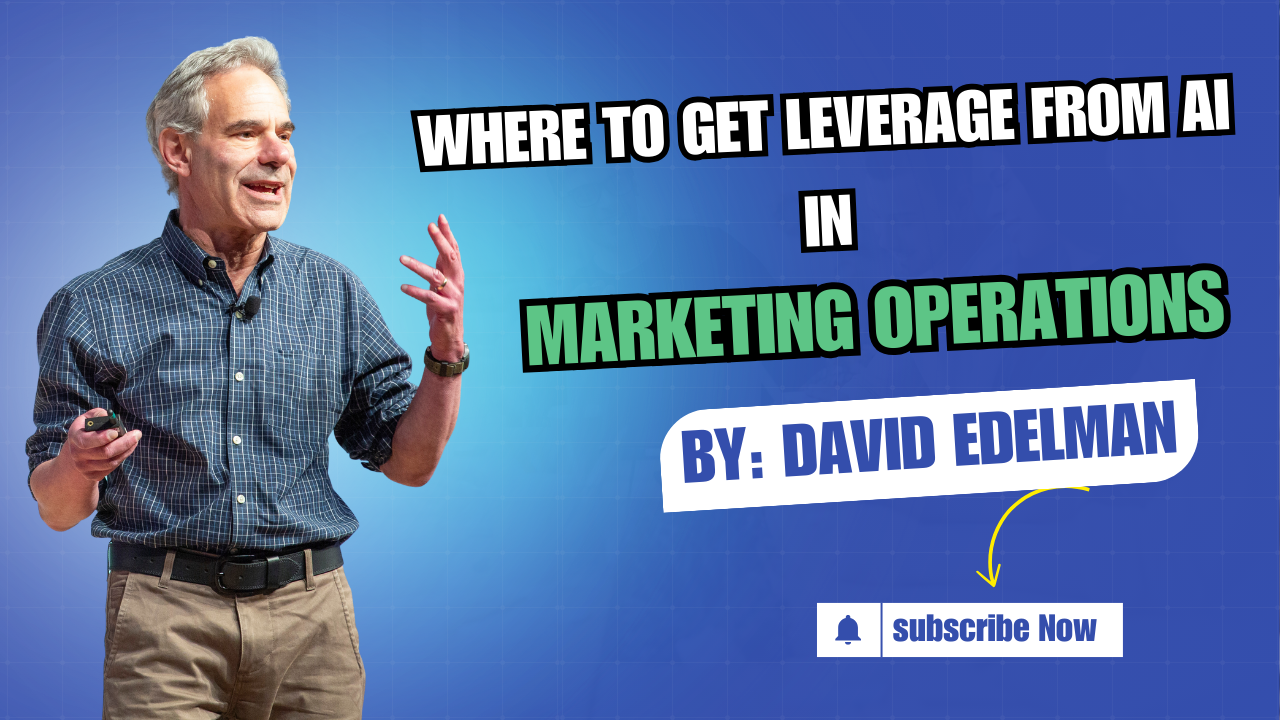
Why Most Personalization Fails – And How to Fix It
Examining why companies deliver bad personalization and what it takes to make it helpful rather than harmful.
In 100 Words
This community session examines why many companies deliver 'bad personalization' and what it actually takes to make personalization helpful rather than harmful. Using the Nespresso example as a trigger, the discussion reframes the issue away from missing data or tools and toward mindset and operating model failures. Participants identify automation left on autopilot, siloed teams, journey blindness, and volume-driven thinking as root causes. Dave introduces a corrective model built on customer-journey-first thinking, relentless test-and-learn, and deliberate expansion of usable data signals. The group agrees that sustainable personalization progress depends less on buying AI and more on orchestration, experimentation, and organizational courage.
Full Session
Key Learning Points
Mindset Over Technology
Most 'bad personalization' is caused by mindset and operating model issues, not lack of data or technology.
Legacy Automation Runs Unchecked
Legacy automation often runs unchecked for years, creating irrelevant or harmful customer experiences.
Siloed Teams Cause Pile-On
Siloed teams and objectives lead to message pile-on rather than coordinated customer conversations.
Customers Are Not List Entries
Treating customers as list entries instead of journey-stage humans drives poor relevance.
Marketing-Service Disconnect
Disconnection between marketing and service/operations data undermines trust and usefulness.
Volume Bias Damages Relationships
Volume bias ('more messages = more conversions') actively damages long-term customer relationships.
Orchestration Over Volume
Effective personalization prioritizes orchestration and sequencing over message volume.
Test-and-Learn Is Essential
Test-and-learn is essential not only for optimization, but for training decisioning and AI systems.
Signals Already Exist
Valuable signals already exist in content metadata, service interactions, and complaints data.
Change How Teams Work
Real progress requires changing how teams work, decide, and take risk—not just adding tools.
Key Action Points
Audit Automated Programs
Audit existing automated programs and shut down or redesign flows running on autopilot.
Reframe Goals
Reframe personalization goals around 'next best conversation,' not campaign throughput.
Map Customer Journeys
Map customer journeys explicitly and define channel roles by journey stage.
Centralize Prioritization
Centralize offer and message prioritization to avoid internal competition for attention.
Move Beyond A/B Testing
Move beyond simple A/B testing toward richer experimentation where feasible.
Instrument Content Metadata
Instrument content with metadata to learn which attributes drive outcomes.
Activate Operational Signals
Activate underused operational signals such as call-center transcripts and complaints.
Start with Small Pilots
Start with small, contained pilots to overcome organizational risk aversion.
Use Stretched Targets
Use stretched growth targets to force experimentation rather than repetition.
Communicate AI Value
Communicate that AI value comes from changing the operating model, not just deploying software.
Full Analysis
1. Purpose of the discussion: The session aims to diagnose why personalization frequently fails in practice and to replace tool-centric explanations with a clearer understanding of behavioral, organizational, and operational root causes.
2. Why "bad personalization" happens: Examples like the Nespresso experience reveal systemic issues: unchecked legacy automation, disconnected teams, and messaging driven by internal incentives rather than customer context. These failures accumulate quietly until customers disengage.
3. Journey blindness as the core failure: Participants highlight that customers are often treated as static records instead of people moving through journeys. Without recognizing states like "new buyer" or "recent complainer," personalization becomes tone-deaf.
4. Orchestration versus free-for-all marketing: Dave contrasts uncontrolled message competition with an orchestrated model where offers are centrally prioritized. Showing one relevant message at a time restores clarity, trust, and performance.
5. Test-and-learn as an operating system: The discussion reframes experimentation as continuous learning rather than isolated optimization. Multi-variant testing feeds both human insight and AI decisioning, improving outcomes over time.
6. Organizational blockers to experimentation: Compliance friction, risk aversion, and rigid ROI expectations slow learning. These constraints often protect legacy performance at the expense of future growth.
7. Being a deliberate "data hound": Rather than waiting for a perfect CDP, teams can unlock value by instrumenting existing content and activating overlooked signals from service and operations. Pragmatic experiments build evidence and momentum.
8. Sales and marketing data alignment: Examples like mandatory data capture for sales credit show how forcing functions can improve downstream personalization and coordination across teams.
9. Mindset before tools: The session reinforces that AI and personalization success begins with asking better questions about customer value, not with acquiring more technology. Tools amplify intent; they do not replace it.
10. Managing risk and change: Practical advice centers on contained pilots, quick wins, and stretched targets to overcome fear-driven inertia. The community positions itself as a safe space to share these experiments and accelerate collective learning.
Bring These Ideas to Your Audience
Book Dave for a keynote, workshop, fireside chat, or executive session on AI, marketing, and customer strategy.