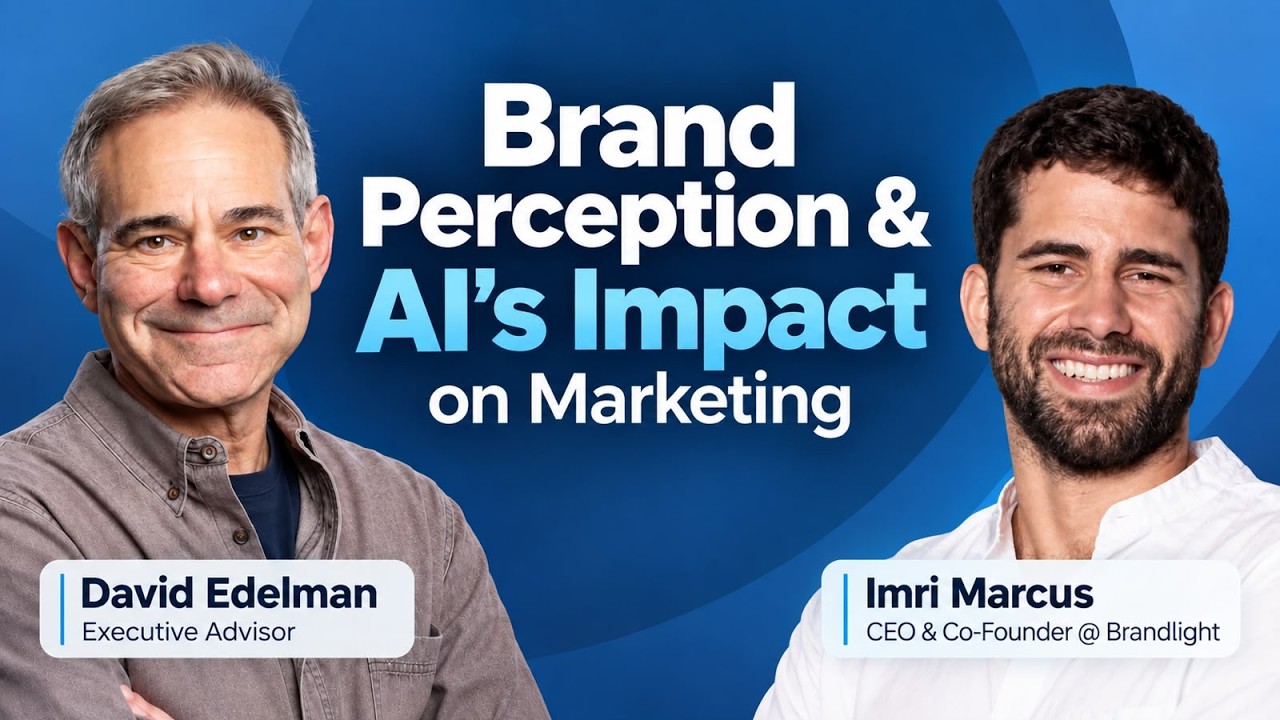
Win Brand Visibility in AI Search
Marketing leaders will learn how to measure, improve, and organize around brand visibility as customers move from traditional search to AI engines.
Dave Edelman in conversation with Imri Marcus (CEO and co-founder of brandlight.ai)
In 100 Words
Dave Edelman and Imri Marcus, CEO and co-founder of brandlight.ai, explain why AI search requires a distinct marketing practice rather than an extension of SEO. The session examines ChatGPT’s rapid growth, Google AI Overviews, declining overlap between conventional rankings and AI-selected sources, and organic traffic losses of 20% to 50% at some large brands. Marcus outlines three strategic dominoes: act rather than wait, choose capable partners, and activate the right internal teams. The conversation also covers visibility and sentiment metrics, content optimization, third-party publishers, paid placements, agentic commerce, and responsible use of AI to produce authoritative, distinctive content.
Full Session
Key Learning Points
AI Search Changes Brand Discovery
Consumers increasingly ask AI engines detailed, contextual questions instead of scanning conventional search results, changing how brands enter consideration sets.
AI Visibility Differs From SEO
AI engines select, assess, synthesize, and present information through mechanics that extend beyond conventional search rankings. Marcus reports that the overlap with SEO results fell from 70% to below 26%.
Considered Purchases Feel Impact First
AI search initially matters most for researched purchases such as CRM systems, cars, phones, and marathon shoes, but shopping agents will extend its influence to categories such as beer and snacks.
Every Engine Uses Different Sources
ChatGPT, Google AI Overviews, Perplexity, and other platforms can rely on different sources for the same category, so marketers cannot optimize against one universal formula.
Visibility Includes Unbranded Demand
Brands must measure whether they appear when customers describe a job to be done without naming a company, as well as how AI engines discuss specific brands and products.
Sentiment Shapes Purchase Progression
AI sentiment matters after a brand enters consideration because positive or negative answers about products such as the Cadillac Lyriq can advance or interrupt a purchase journey.
Content Needs Three Decisions
Effective AI-search content requires evidence-based decisions about what to address, where to publish it, and which structure or schema works for the brand, category, and engine.
Third-Party Authority Is Contextual
Reddit, YouTube, publishers, communities, and other sources can influence AI answers, but their value varies by engine, vertical, product, and customer question.
Organization Determines Response Speed
SEO and content teams can lead early execution, but management and other functions must participate because AI visibility affects partnerships, paid media, brand strategy, and resource allocation.
AI Accelerates Quality And Spam
AI can make strong writers more productive and help close content gaps, but unguided mass production lowers quality, weakens differentiation, and risks eroding trust.
Key Action Points
Establish An AI Visibility Baseline
Measure how often the brand and its competitors appear across branded and unbranded queries in ChatGPT, Google AI Overviews, Perplexity, and other relevant engines.
Map Complete Customer Journeys
Test prompts that begin with a customer’s job to be done, progress into comparisons, and finish with product-specific questions to reveal visibility and sentiment throughout consideration.
Separate SEO And AI Workstreams
Maintain effective SEO while building a distinct AI visibility practice; shared content and expertise do not make the two disciplines interchangeable.
Prioritize High-Value Content Gaps
Identify the customer questions and product considerations where the brand underperforms, then create focused content rather than simply increasing publishing volume.
Choose The Right Publishing Location
Determine whether each asset should live on the main website, a community page, a subdomain, or a relevant third-party property based on observed AI-source patterns.
Audit Influential External Sources
Find the publishers, forums, social platforms, and YouTube channels that disproportionately shape AI answers, including smaller domains overlooked by traditional traffic metrics.
Build A Cross-Functional Operating Model
Give SEO and content leaders an execution role while involving senior management, brand, partnerships, social, paid media, technology, and analytics in strategic decisions.
Use AI With Expert Direction
Provide AI writing tools with original insights, clear briefs, brand voice, source requirements, and human review so they increase productivity without creating generic content.
Prepare For Paid And Agentic Search
Use current organic visibility data to anticipate where paid AI placements and automated purchasing agents could most strongly affect consideration and conversion.
Monitor Algorithms Continuously
Track source and response changes frequently because the tactics that work for a specific engine or category can shift within months or even days.
Full Analysis
1. AI Search Is Already Mainstream: Marcus argues that AI search is not a future channel. He cites ChatGPT growth of 400% toward nearly one billion active users and says roughly 60% of Google searches begin with an AI Overview, occupying about 40% of the screen before conventional links. He also reports that Gen Z chooses AI engines over traditional search methods more than 50% of the time. The behavioral difference is significant: a customer can replace a broad query such as “best pickup truck 2025” with requirements covering work use, two children, infotainment, a three-hour daily drive, and fuel efficiency. That context lets an engine construct a personalized consideration set rather than merely return links.
2. The Impact Extends Across Categories: Considered purchases face the earliest pressure because customers naturally research them. Marcus includes enterprise CRM systems, cars, mobile phones, and marathon shoes, showing that the issue cuts across B2B and B2C and is not limited to expensive products. Heineken illustrates the next phase. A host planning for 35 people could ask an AI assistant to create a shopping list and implicitly choose between Heineken and Corona or Pepsi and Coca-Cola. With ChatGPT integrating Shopify, Amazon developing Rufus, and Perplexity offering Shop with Perplexity, recommendations can flow directly into transactions. AI visibility therefore becomes commercially relevant even for routine consumer goods.
3. AI Optimization Is Not SEO: The session distinguishes generative engine optimization from conventional SEO. An AI engine may retrieve candidate pages through a search-like process, but it then assesses content, chooses evidence, synthesizes an answer, and decides how prominently to mention each brand. Marcus says overlap between standard search rankings and AI-selected material was once about 70% but had fallen below 26% and was continuing to decline. He also shows that ChatGPT and Google AI Overviews use different sources for the same luxury hotel and financial-services contexts. SEO still supports page discovery, but ranking well does not guarantee inclusion, recommendation, or favorable framing in an AI-generated answer.
4. Visibility Loss Creates A Dark Funnel: Some large brands are losing 20% to 50% of organic traffic, according to Marcus, while customer consideration increasingly occurs inside closed AI environments. This creates a “dark funnel”: an engine may educate a buyer, compare options, answer objections, and make a recommendation without producing a measurable referral click. The customer may later search the selected brand by name and buy, causing conventional attribution to credit the final navigation rather than the AI interaction that created preference. Marketers therefore need measurement beyond website traffic. The immediate priorities are share of AI visibility, recommendation position, answer quality, sentiment, competitor presence, and performance across complete customer journeys.
5. Influence Requires Query-Level Evidence: Generic advice such as publishing question-and-answer pages or earning Reddit mentions is directionally useful but insufficient for enterprise decisions. Marcus explains that Reddit can matter differently in ChatGPT than in Google AI Overviews and differently for secure banking than for automotive. Brandlight’s approach analyzes millions of branded and unbranded queries, competitor appearances, sentiment, recommendation position, and the sources behind synthesized answers. That creates what Marcus calls a “heat map of the internet” for a brand. The practical goal is to identify which domains, formats, structures, and topics actually move visibility for a particular product and engine rather than applying one generalized checklist across every market.
6. Content Strategy Has Three Pillars: Marcus defines three decisions behind an effective piece of AI-search content: what to write about, where to place it, and how to write it. The first requires identifying considerations where the brand underperforms. The second may point to the corporate website, community pages, a subdomain, or an external property. The third examines structures and schemas that work for the company, competitors, and vertical. External influence can be counterintuitive. Marcus describes a top-10 source set in which five domains average 30 million visitors while another has fewer than 500,000, yet the smaller publisher still materially shapes AI visibility. Conventional audience size can therefore undervalue strategically important partnerships.
7. Three Dominoes Guide Mobilization: Winning enterprises address three “dominoes.” First, they act instead of waiting for perfect certainty because AI recommendations already create a zero-sum consideration game. Second, they select partners capable of monitoring rapidly changing technology, algorithms, engines, and category-specific source patterns. Third, they activate the right internal teams. SEO leaders are often well positioned to champion the work because they understand discovery and content operations, but Marcus says management must participate because AI search could become the largest marketing channel of the next decade. Content, social, partnerships, paid media, technology, and analytics also matter when evidence points to new publishers, platforms, or investment priorities.
8. AI Can Scale Distinctive Content: Dave asks whether tools such as Jasper and Writer can use visibility findings to close content gaps. Marcus says yes, provided the system receives strong inputs about the topic, publishing location, and effective structure. He describes AI as an accelerant: it can help talented writers become architects of a broader content strategy, but it can also produce enormous quantities of weak material. The session rejects the simplistic question of whether AI or a person wrote an asset. A knowledgeable person can supply original ideas, direct the argument, revise the language, and protect brand voice while AI supports drafting. Expertise, experience, authority, trust, and distinctiveness still depend on disciplined editorial control.
9. Commerce And Paid Search Come Next: The channel will not remain purely organic. Marcus notes that Perplexity has tested advertising and estimates its beta pricing at about 20 times the cost of Google ads because AI interactions may carry greater intent. Google is also experimenting, while ChatGPT, Shopify, Amazon Rufus, and Perplexity are shortening the path from recommendation to purchase. Agentic search could go further: a traveler might instruct an assistant to buy a Miami flight under $1,000, allowing the agent to choose United or Delta and complete payment. Brands need organic visibility intelligence before these systems mature because it indicates which product considerations, competitive gaps, and funnel stages deserve paid investment.
Frequently Asked Questions
What is AI search visibility?
AI search visibility is the frequency, prominence, and quality with which a brand appears in answers generated by platforms such as ChatGPT, Google AI Overviews, and Perplexity. It includes whether the brand enters unbranded consideration queries, where it is recommended, how it compares with competitors, and whether the answer’s sentiment supports or discourages purchase.
How is AI search optimization different from SEO?
AI search optimization addresses how engines retrieve, evaluate, synthesize, and present information, while SEO primarily improves discovery and ranking in conventional search results. Marcus reports that overlap between traditional rankings and AI-selected sources declined from about 70% to below 26%. Brands should retain SEO but manage AI visibility as a separate, complementary practice.
How can a brand improve its visibility in ChatGPT and Google AI Overviews?
A brand can improve AI visibility by mapping relevant customer prompts, identifying weak topics and product considerations, analyzing sources cited by each engine, and publishing authoritative content in the locations and formats that influence those answers. The right tactic varies by engine and vertical, so query-level monitoring is more reliable than universal prescriptions about Reddit, keywords, or FAQs.
Which KPIs should marketers use for AI search?
Marketers should track AI visibility, recommendation position, answer quality, sentiment, competitor share, and performance across branded and unbranded customer journeys. For example, increasing appearance in relevant answers from 17% to 41% would represent a substantial gain. These measures address the dark funnel where AI shapes consideration without sending a trackable website click.
Should SEO teams own AI visibility?
SEO teams are often best equipped to start AI visibility work because they understand search, content, and technical discovery. They should not operate alone. Senior management, content, brand, social, partnerships, paid media, technology, and analytics must participate because AI answers affect narrative control, publisher strategy, investment allocation, measurement, and commerce.
Can companies safely use AI to create search content?
Companies can use AI effectively when experts supply original insights, specify the audience and purpose, require credible evidence, preserve brand voice, and review the result. AI is an accelerant rather than a substitute for judgment. Unguided mass production creates generic or low-quality material, while expert-directed tools can expand output and help strong writers manage a more sophisticated content strategy.
Bring These Ideas to Your Audience
Book Dave for a keynote, workshop, fireside chat, or executive session on AI, marketing, and customer strategy.