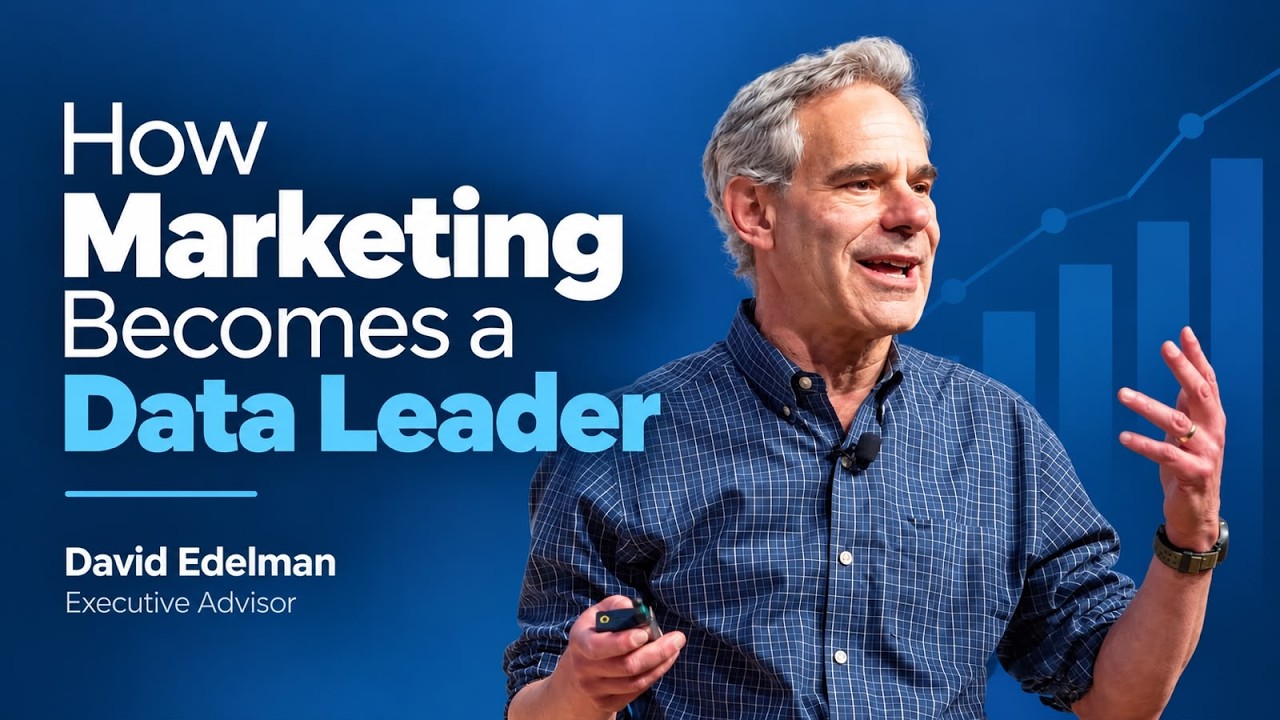
How Marketing Leaders Build Better Data Strategy
Marketing leaders learn how to map data flows, align teams, improve measurement, and build the foundations for AI-powered personalization.
In 100 Words
Dave Edelman and participating marketing, technology, and customer experience leaders discuss why marketing must help shape enterprise data strategy. The session explains how disconnected agency, sales, CRM, e-commerce, and service data obstruct insight, decision-making, attribution, and personalization. Dave recommends quarterly data days, visible architecture maps, business-led use cases, stronger data ownership, and cross-functional collaboration. Examples include Apple’s 500-plus stores, Aetna’s 25 creative tags and five-question preference exercise, and a property manager using Snowflake, Tealium, CRM, and Adobe without a shared data model. The conversation also examines zero-party data, call center intelligence, test-and-learn cultures, and granular content measurement.
Full Session
Key Learning Points
Marketing Must Lead Data Strategy
Marketing depends on data to generate customer insight, make targeting and budget decisions, and demonstrate business impact. That dependence gives marketing both a reason and a mandate to shape enterprise data priorities.
Start With Business Outcomes
Data investment gains support when it connects directly to revenue growth, cost reduction, customer experience, or NPS. Ari describes using those outcomes as a North Star before discussing platforms or data unification.
Map Every Data Flow
A visible map of systems, owners, inputs, and outputs exposes missing connections and conflicting sources. One company discovered disconnected Snowflake, Tealium, CRM, and Adobe environments only after putting the architecture on paper.
Hold Quarterly Data Days
A quarterly data day gives marketing leaders dedicated time to review data quality, access, robustness, use cases, and organizational dependencies. The findings can then become a focused C-suite agenda item.
Reclaim Agency-Controlled Data
Brands should own the advertising accounts, data, and insights generated through agency relationships. Without direct access, marketing cannot independently analyze performance, connect outcomes, or build durable organizational capability.
Instrument Creative At Component Level
Creative should be tagged by variables such as color, font size, imagery, and language rather than measured as one indivisible asset. At Aetna, outbound materials carried 25 tags to identify which elements influenced performance.
Ask Customers Directly
Zero-party data can reveal preferences and trade-offs that behavioral inference misses. Aetna used five simple comparison questions, structured like a conjoint exercise, to generate data for individual personalization.
Use Service Conversations As Data
AI-enabled call center platforms can identify competitor mentions, education gaps, attrition risk, product problems, and life changes. Marketing must arrange for both aggregate themes and customer-level signals to flow into its systems.
Measure Learning, Not Milestones
Traditional technology-project metrics can block useful experimentation. Data and MarTech programs should be judged partly by whether teams produce actionable learning, not only whether implementations meet dates and budgets.
Data Work Requires Culture Change
Granular measurement can disprove assumptions backed by agencies or internal teams. Leaders should frame those findings as opportunities to improve decisions rather than as judgments on the people who produced the work.
Key Action Points
Schedule a Quarterly Data Day
Bring marketing leaders together every quarter to assess business goals, required data, current access, quality problems, ownership, measurement gaps, and dependencies on other functions.
Draw the Current Architecture
Create one visual showing Snowflake or other warehouses, CDPs, CRM, Adobe or comparable platforms, e-commerce systems, agency accounts, sales tools, service platforms, and the data exchanged among them.
Document Priority Use Cases
Write down the personalization, attribution, budget allocation, testing, retention, and customer experience use cases the business wants. Show exactly which data flows each use case requires.
Secure C-Suite Sponsorship
Ask the CEO or COO to reserve time for a cross-functional data discussion. Present the value at stake, the most consequential gaps, the help marketing needs, and a prioritized remediation plan.
Establish Brand Data Ownership
Audit agency-managed advertising accounts, website analytics, campaign data, and reporting environments. Transfer ownership or guarantee direct brand access before the next contract renewal.
Create a Creative Taxonomy
Define standard tags for copy, images, offers, colors, layouts, calls to action, and other variables. Apply them consistently so performance analysis can isolate the elements that drive response.
Connect Sales and Marketing Analysts
Pair analysts from sales and marketing to reconcile definitions, link campaign activity to pipeline, and explain findings to leadership. James’s organization used this bridge after nearly a year of persuasion.
Launch Zero-Party Data Questions
Ask a short set of preference or trade-off questions at relevant journey points. Store the answers in the customer record and use them visibly so customers receive a more relevant experience.
Integrate Call Center Signals
Work with service and technology teams to route aggregate conversation themes and customer-level risk, need, and life-event signals into marketing workflows and CRM records.
Reset Program Success Metrics
Add learning velocity, actionable findings, data usability, and experiment adoption to MarTech program scorecards. Do not allow schedule and budget compliance to remain the only definitions of success.
Full Analysis
1. Why Marketing Has to Lead: Dave argues that marketing cannot remain a “luncheonette,” producing whatever product teams or business units request. Modern marketing needs data for three core jobs: developing insight, making decisions, and proving impact. Yet the required information often sits with agencies, sales teams, e-commerce groups, Salesforce environments, or other functions. Marketing therefore has to advocate for access, linkage, and ownership. This is not an attempt to replace the CIO. It is a business leadership responsibility: if executives expect marketing to improve growth and demonstrate returns, they must support the data foundations that make targeting, budget allocation, attribution, testing, and AI-powered personalization possible.
2. Business Value Comes Before Technology: Ari, who works on omnichannel personalization at Apple across online channels, more than 500 stores, and contact centers, recommends beginning with outcomes everyone accepts: revenue growth, lower costs, stronger customer experience, or improved NPS. Personalized recommendations can then become a defined route to those outcomes, with unified data positioned as an enabler rather than an abstract technology goal. Dave reinforces this logic because investment will not follow a platform-first argument. Paul adds urgency: an IT-led Adobe program was implementing a view of marketing that was already two years out of date. Marketing must articulate valuable use cases early, before technology teams lock outdated assumptions into the architecture.
3. Data Days Create Executive Momentum: Dave recommends a quarterly data day or half-day in which marketing pauses routine work and examines the data behind its business goals. The team should assess quality, access, robustness, ownership, measurement, experimentation, and the help required from other functions. At one client, the CMO converted the output into an hour on the C-suite agenda with support from the COO. The CEO valued the exercise because it exposed why ambitions for AI, digital operations, and personalization were stalling. Sam’s experience shows that teams may first need basic education: colleagues jumped directly to desired tools, insights, and staffing without identifying the inputs needed to produce those outcomes.
4. Architecture Maps Expose Hidden Waste: At the first data day for one of Dave’s clients, a half-day session ran past lunch because nobody understood how the systems connected. The company had a Snowflake data lake, Tealium CDP, CRM, and an Adobe implementation, but teams used inconsistent data and disputed numbers with sales. Even the CIO organization lacked an integrated view. Mapping the systems revealed both capability gaps and potential savings from simplification. The client, a major manager of apartment rentals, also collected information separately at lead, sale, and resident stages. That fragmentation forced customers to answer the same questions and complete forms again instead of continuing one coherent relationship.
5. Customer Journeys Clarify Fragmentation: Ari suggests mapping data architecture through the customer journey because employees can readily understand one customer moving across moments and touchpoints. The approach reveals where a lead becomes a customer but also enters an entirely different system. It reminds teams that customers do not perceive ten departments, platforms, or data owners. Alex Chong described the consequences of ignoring entry points at a multi-billion-dollar company. After buying a customer data platform, the business discovered customer records with ten last names and 20 email addresses. Newsletter sign-ups could be repeated using several addresses, leaving no dependable source of truth. Fixing the resulting mess took years.
6. Instrumentation Turns Creative Into Data: Dave distinguishes measuring an entire asset from learning which components make it effective. At Aetna, every outbound item was tagged against 25 attributes, including color, font size, background image, and the presence of specific words. Platforms such as Adobe can support this, while newer AI tools can tag batches of creative automatically. The opportunity grows with generative AI: teams can produce five variants quickly, but those variants generate useful learning only when their differences are recorded. James offers evidence of the payoff. His organization produced roughly 12 research assets annually, but only one mattered, and about 80% of even that asset was noise; two images in six pages drove interest.
7. Measurement Changes Internal Power Dynamics: Granular measurement can challenge work backed by large budgets, agency confidence, or internal reputation. Ari notes that attribution and telemetry may show that a heavily supported tagline, campaign, or asset performs poorly. James encountered the same tension when researchers learned that most of their output did not influence customers. The answer is not to retreat from measurement but to position evidence as a method for improving future work. Paul warns that delivery culture can still defeat learning: one Adobe implementation team rejected new data requirements because it had April milestones and suggested waiting 18 months. Organizations need success measures based on actionable learning, not schedules alone.
8. Customers Can Supply Better Signals: Marketing can create valuable data instead of only integrating existing databases. Dave contrasts indiscriminate retargeting with direct questions. After viewing drill bits on Grainger’s website, he received daily Gmail promotions covering unrelated areas such as security and cleanup, and clicking a promoted product led to a general catalog page. Grainger could instead ask what he needs. At Aetna, Dave and Tim used five simple “Is this more important than that?” questions in Medicare marketing. The conjoint-style exercise captured customer trade-offs and produced personalization data more powerful than other available sources. This zero-party data can also strengthen attachment when the brand visibly uses the answers.
9. Call Centers Are Marketing Sensors: AI-enabled call center systems can digitize and interpret customer conversations, but their output often remains inside service operations. Dave identifies two useful levels. Aggregate analysis can reveal competitor offers, recurring product confusion, and topics requiring education. Customer-level analysis can flag attrition risk, difficulty using a product, or a life change that makes a cross-sell relevant. He cites DataOrb as one company working with telecommunications providers, while stressing that a special tool is not always necessary because major contact center platforms increasingly include these capabilities. Marketing’s job is to specify the signals it needs and create a route into CRM, targeting, and content workflows.
Frequently Asked Questions
Why should marketing lead data strategy?
Marketing should help lead data strategy because customer insight, targeting, budget allocation, attribution, experimentation, and personalization all depend on accessible, connected data. The CIO may own technology, but marketing must define the business use cases, identify missing flows, quantify the value, and mobilize sales, service, product, agencies, and technology teams around the required capabilities.
What is a marketing data day?
A marketing data day is a quarterly working session focused on the data required to achieve business goals. Leaders review architecture, quality, access, ownership, use cases, measurement gaps, and cross-functional dependencies. The output should be a prioritized plan and a concise C-suite discussion explaining what is blocked, why it matters, and which teams must help.
How should a company map its marketing data architecture?
A company should draw every major data source, system, owner, entry point, and flow on one page, then connect that map to priority customer journeys and marketing use cases. The view should include warehouses, CDPs, CRM, advertising accounts, web analytics, e-commerce, sales, service, product usage, agency-held data, and the definitions teams use for shared metrics.
How can marketers generate better personalization data?
Marketers can generate better personalization data by tagging creative variables, running structured experiments, asking customers preference questions, analyzing product usage, and incorporating call center signals. Aetna tagged outbound work across 25 attributes and used five simple trade-off questions in Medicare marketing, producing direct preference data that could guide individual experiences.
What is zero-party data in marketing?
Zero-party data is information customers intentionally provide about their needs, preferences, priorities, or circumstances. Brands can collect it through short questions, preference centers, interviews, communities, or guided selection tools. It is especially useful for personalization because it captures what a customer explicitly values rather than forcing marketing to infer intent from clicks or browsing alone.
How can marketing regain control of agency data?
Marketing can regain control by auditing agency-managed advertising accounts, analytics environments, campaign records, and reporting processes, then requiring brand ownership or direct access. Contracts should specify data portability, account administration, taxonomy standards, and handover obligations. The goal is to preserve agency expertise without allowing a third party to become the sole custodian of the brand’s performance data.
Bring These Ideas to Your Audience
Book Dave for a keynote, workshop, fireside chat, or executive session on AI, marketing, and customer strategy.