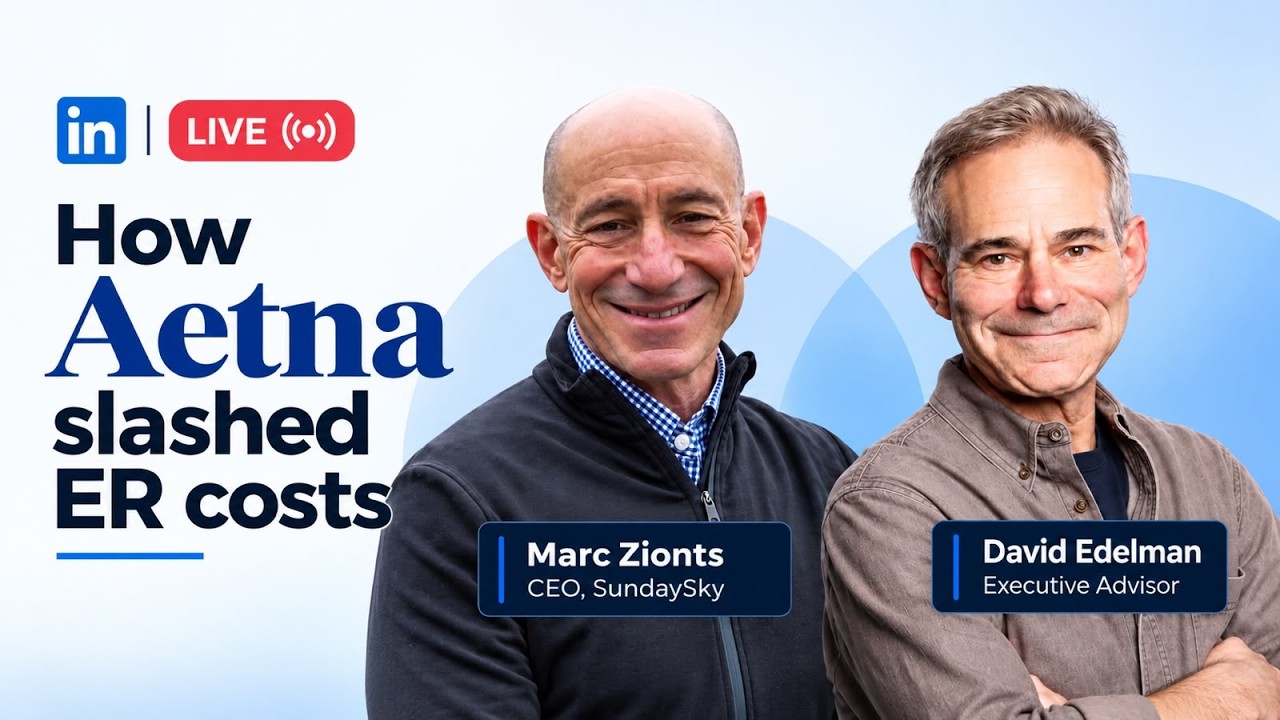
How Aetna Cut Unnecessary ER Visits 75% with Personalized Video
For marketing and customer experience leaders seeking practical ways to create, personalize, govern, and measure enterprise video at scale.
Dave Edelman in conversation with Mark Zionts (CEO of SundaySky)
In 100 Words
Dave Edelman and SundaySky CEO Mark Zionts discuss how personalized video can improve customer understanding while lowering service costs. Dave shares Aetna results: more than 70% of members watched a three-and-a-half-minute onboarding video, call center volume fell over 20%, and unnecessary emergency room visits dropped 75%. Mark explains how SundaySky turns articles, customer data, and existing assets into modular, brand-controlled videos. The platform connects with systems including Salesforce, Marketo, HubSpot, and Snowflake, rendering current information in real time without retaining sensitive data. The conversation also covers short-form design, conditional scenes, AI copilots, testing, security, analytics, and digital-first customer service.
Full Session
Key Learning Points
Personalized Onboarding Changes Behavior
At Aetna, more than 70% of members watched a three-and-a-half-minute personalized onboarding video, contributing to over 20% fewer call center calls and 75% fewer unnecessary emergency room visits.
Short Video Improves Comprehension
Relevant, concise video works best at important journey moments because it combines visual explanation, narration, and text in a format customers are more likely to consume.
Modularity Makes Video Maintainable
SundaySky breaks videos into reusable scenes, allowing teams to update individual elements, apply conditional logic, and change branding without rebuilding every asset.
Real-Time Data Drives Relevance
Connections to Salesforce, Marketo, HubSpot, Snowflake, APIs, URL parameters, Google Sheets, and CSV files can determine which scenes, messages, offers, and next actions each viewer receives.
AI Accelerates Human-Controlled Creation
SundaySky reduced production from weeks or months to an hour or less with AI, while keeping enterprise users in control of scripts, media, branding, pronunciation, and publishing.
Existing Content Provides Fast Inputs
Amazon Business converts material from a help center containing about 600 articles into short videos by placing article text into SundaySky's AI copilot and then refining the output.
Conditional Scenes Prevent Repetition
A personalized onboarding video can skip completed steps, acknowledge actions already taken, and recommend the next best action based on current customer data.
Enterprise Video Requires Governance
Scalable video needs more than text-to-video generation; it requires brand controls, secure data handling, real-time rendering, integrations, publishing options, and analytics.
Testing Replaces Creative Guesswork
Aetna used split tests across three alternatives, with 30%, 30%, and 40% of viewers assigned to different versions, then compared completion and action rates.
Digital-First Service Supports Scale
Companies can use personalized video for onboarding, renewals, automated business reviews, release notes, loyalty updates, and support without adding people at the same rate as customers.
Key Action Points
Prioritize High-Friction Journey Moments
Identify communications that customers routinely ignore or misunderstand, such as onboarding materials, benefit explanations, release notes, renewal notices, loyalty statements, and support instructions.
Define One Behavioral Outcome
Give each video a specific objective, such as completing onboarding, using an urgent care center, adopting a feature, booking an appointment, or purchasing a product.
Convert Existing Content First
Start with proven source material such as help articles, email sequences, call center scripts, product notes, or account statements rather than drafting every video from scratch.
Keep Each Message Concise
Use 30- to 45-second formats for many marketing communications, approximately 60 seconds for feature summaries, and a short series rather than a single five- to ten-minute business video.
Map Data to Scene Logic
Specify which customer fields should appear directly and which should determine whether scenes play, including products purchased, support tier, onboarding status, location, loyalty level, and account activity.
Establish Brand Controls Upfront
Load approved logos, fonts, hex colors, sub-brands, pronunciation rules, music, and reusable media before expanding video creation across frontline teams.
Retain Human Editorial Control
Treat AI output as a starting point that may be 70% complete, then correct factual errors, awkward pronunciation, imagery, pacing, calls to action, and brand voice.
Run Structured Split Tests
Test scripts, scene order, visuals, offers, and calls to action across defined audience groups, then compare completion, clicks, downstream behavior, and service demand.
Measure Value Beyond Views
Track scene-level drop-off, repeat viewing, calls to action, Net Promoter Score, call center demand, feature adoption, and operational outcomes rather than relying on play counts alone.
Design for Secure Real-Time Rendering
For financial, healthcare, or insurance applications, retrieve contemporary data only when the viewer presses play and avoid pre-rendering or unnecessarily retaining sensitive customer records.
Full Analysis
1. Aetna Proved the Operational Case: Dave's Aetna experience shows why personalized video should be evaluated as an operational intervention, not merely a creative format. Each new member received a three-and-a-half-minute explanation covering the selected plan, covered family members, available benefits, and nearby in-network urgent care centers. More than 70% watched it. Calls to the call center fell by over 20%, while unnecessary emergency room visits declined 75% as members were directed toward appropriate urgent care. Email engagement and Net Promoter Score also rose. The result connected clearer communication to lower service demand, lower healthcare costs, and stronger customer trust.
2. Video Belongs Throughout the Journey: The conversation moves video beyond acquisition advertising into onboarding, education, service, retention, and expansion. Mark cites software use cases including renewal notices, upsell opportunities, automated quarterly business reviews, product release notes, and customer onboarding. Beacon Building Materials uses personalized videos for loyalty updates, showing customers their status, unused benefits, and offers that can earn additional points. Its service representatives are also exploring videos that explain how to use particular products. These examples share a clear principle: use video where customers must understand information or take action, especially when the current alternative is a dense email, document, statement, or script.
3. Short Form Requires Editorial Discipline: Mark argues that business communication must account for reduced reading and shorter attention spans. He recommends roughly 30 to 45 seconds for many marketing messages and advises against turning ten minutes of material into a ten-minute business video. Product announcements can summarize each of three features in 30 or 40 seconds, remain within a couple of minutes, and link viewers to deeper help content. Longer subjects should become a sequence with explicit next steps. The objective is not simply brevity; it is progressive disclosure. Each installment should explain one useful idea, invite a relevant action, and allow the customer to choose whether to continue.
4. Modular Production Changes Video Economics: Traditional agency production could take four to six weeks or several months, cost heavily, and leave a static asset that became expensive to update. SundaySky first compressed that process to days and now uses AI to bring it to an hour or less, with newer capabilities targeting minutes. Its workspace decomposes a video into scenes and supplies built-in transitions, music, voices, media generation, aspect ratios, and templates. A creator does not need Adobe After Effects expertise. Because logos, fonts, colors, and themes are managed centrally, a brand update can flow into the next playback instead of requiring teams to reopen and replace every finished file.
5. Personalization Is Logic, Not Just Names: The Okta example demonstrates that enterprise personalization extends beyond inserting a first name. Data can determine which scenes play according to the products purchased, support plan selected, app download status, company, and completed onboarding steps. A premier support customer might see an assigned account manager's picture and a direct contact action, while a customer with community-only support sees the appropriate resources. If a user completes two of five onboarding tasks, the next viewing can omit those tasks and advance to the next best action. This scene-level logic makes communication more useful while avoiding the repetition that often makes automated customer journeys feel impersonal.
6. Real-Time Rendering Preserves Currency: SundaySky retrieves data when a viewer presses play, applies it to the template and conditional logic, and renders the result in real time on AWS. This avoids pre-rendering and storing more than 100 million individual files for programs such as United Airlines MileagePlus. It also means a T. Rowe Price retirement update can reflect current year-to-date data each time it is watched. Dave describes Aetna combining a member's Salesforce address with a national database of in-network urgent care centers, then rendering the three nearest options on a map. Real-time assembly makes a reusable video behave more like a dynamic application than a fixed media file.
7. Enterprise AI Needs Control and Security: Mark distinguishes an enterprise video platform from a one-time generative video tool. SundaySky integrates components from Google, OpenAI, Tavus, and ElevenLabs, but the customer controls the script, assets, brand, data, logic, publishing, and analytics. He notes that an emerging model such as Veo 3 may cost about $0.75 per second, with repeated generations increasing expense and uncertainty. For regulated customers including Schwab and Morgan Stanley, data handling is equally important. SundaySky is SOC 2 and HIPAA compliant, renders information for playback, and avoids keeping sensitive records. AI assists production; it does not displace enterprise governance.
8. Existing Knowledge Can Become Video: Amazon Business offers a practical route to scale: it has a help center containing about 600 articles and uses those articles as inputs to SundaySky's AI copilot. Teams copy an article into the system, generate a short-form draft, and refine it for brand consistency so customers can either read or watch the explanation. This approach avoids waiting for entirely new editorial programs. Companies already possess source material in knowledge bases, release notes, training documents, support scripts, and customer emails. The highest-return starting point is often to convert concise, validated material, then use analytics to learn which visual explanations improve comprehension and action.
9. Measurement Must Link to Business Value: SundaySky analytics can show which scenes viewers watched, where they dropped off, which calls to action they selected, and how they responded to an optional Net Promoter Score survey. Dave adds that Aetna used three-way split tests, assigning 30%, 30%, and 40% of members to alternative treatments and comparing completion and downstream actions. The strongest measures go beyond viewing: fewer service calls, lower avoidable emergency room use, completed onboarding steps, feature adoption, loyalty activity, and improved NPS. ZoomInfo's scale illustrates the need for this discipline: onboarding 1,600 customers per month requires digital-first motions whose value can be demonstrated, not merely content production volume.
Frequently Asked Questions
How did personalized video reduce Aetna's healthcare and service costs?
Aetna sent each new member a three-and-a-half-minute video explaining plan coverage, family members, benefits, and nearby in-network urgent care centers. More than 70% watched it, call center calls fell over 20%, and unnecessary emergency room visits dropped 75%. The program also improved email engagement and Net Promoter Score.
What is the difference between personalized video and generative AI text-to-video?
Enterprise personalized video combines controlled creation with real-time customer data, conditional scenes, brand governance, secure integrations, publishing, and analytics. Generative text-to-video tools primarily create media from prompts. SundaySky uses AI components from partners including Google, OpenAI, Tavus, and ElevenLabs, while leaving customers in control of the final communication.
How does real-time personalized video work?
When an identified viewer presses play, SundaySky retrieves authorized data through a connector or API, applies it to a modular template, selects scenes according to conditional logic, and renders the video in real time. The content can therefore reflect current account data and completed actions without pre-rendering and storing a separate file for every customer.
Which customer journey moments are best suited to personalized video?
Personalized video is most useful when customers must understand complex information or take a specific action. Strong applications include onboarding, plan education, product releases, renewals, automated business reviews, loyalty summaries, feature adoption, support instructions, benefits updates, upsell offers, and next-best-action recommendations.
How long should an enterprise customer video be?
Many marketing videos should run about 30 to 45 seconds, while a concise feature explanation may take approximately 60 seconds. A few minutes can work for important onboarding information, as Aetna's three-and-a-half-minute example showed. Five- to ten-minute business videos should generally be divided into shorter installments with clear calls to action.
How should companies measure personalized video performance?
Companies should measure scene completion, drop-off, repeat viewing, call-to-action clicks, Net Promoter Score, onboarding progress, feature adoption, call center demand, and operational outcomes. A/B or multivariate tests can compare scripts, visuals, scene order, and offers. Aetna tested three versions across 30%, 30%, and 40% audience groups before scaling decisions.
Bring These Ideas to Your Audience
Book Dave for a keynote, workshop, fireside chat, or executive session on AI, marketing, and customer strategy.